Thursday, March 1, 2012

Russia in Winter: From Siberia to the Arctic Circle...


Siberia to the Arctic Circle! 
We compiled a short film with footage of our time in Siberia and our journey to the Arctic Circle. 


Our second stop on the Trans-Siberian Railroad was Siberia itself - specifically, the city of Irkutsk, Russia. Our first day in the city was plagued by injury...


Kelly was not very successful at attempting an ice slide in standing position (frequently done, and encouraged, by locals) ...Escaping with only a minor concussion, a fractured nose, and a very fat lip, we considered ourselves very lucky and avoided ice sports...for a few days.

After Kelly felt she was mostly recovered we headed for Lake Baikal - our primary purpose for visiting Siberia. Our lovely and gracious Irkutsk host, Satine,  introduced us to her friend, Victor, who welcomed us to his base camp on Olkhon Island in Lake Baikal. In winter, Olkhon Island is only accessible via the ice highway that forms atop the frigid waters. So, in Victor's Subaru, driven by his friend Ivon - with Freddy Mercury and Pink Floyd gracing the speakers - we took to the ice.
The waters of Baikal are so clear that even frozen you can see through to the water. In summer you can see as much as 130 ft below the surface - giving many people vertigo while swimming!

As soon as we arrived we were welcomed with some homebrewed "siberski" (siberian whisky) - made straight form the waters of Baikal and distilled through charred wood chopped on the island.
Our first night we enjoyed omul cavier (endemic to the waters of Baikal), steak and potatoes, salted cabbage and carrots, mushroom salad and lots and lots of siberski.
After sleeping on many floors, train stations, the occasional couch and beach, we were glad to call hut #10 home for a few days...

In the morning, we ventured across the island to the northern most tip. 

 Of course, when you are traveling across miles of Siberian tundra it is not surprising to get stuck...several times.
 Lunch! Fish, pickles, bread and mayo.
 ...and siberski. We knew the Russian phrase for "no, thank you"but it never seemed to translate...And we didn't even think to ask how they managed to get "clementines" in Siberia in February. 
 Krewe du Siberia! From the left: Sirgue, Victor, Kelly & Chris!
 The views were absolutely spectacular...
 Kelly is pointing to a tiny red Fiat making the drive across the lake.


 Supper! Fish soup! Omul with potatoes cooked right on the tundra...

And nothing went to waste...nothing.
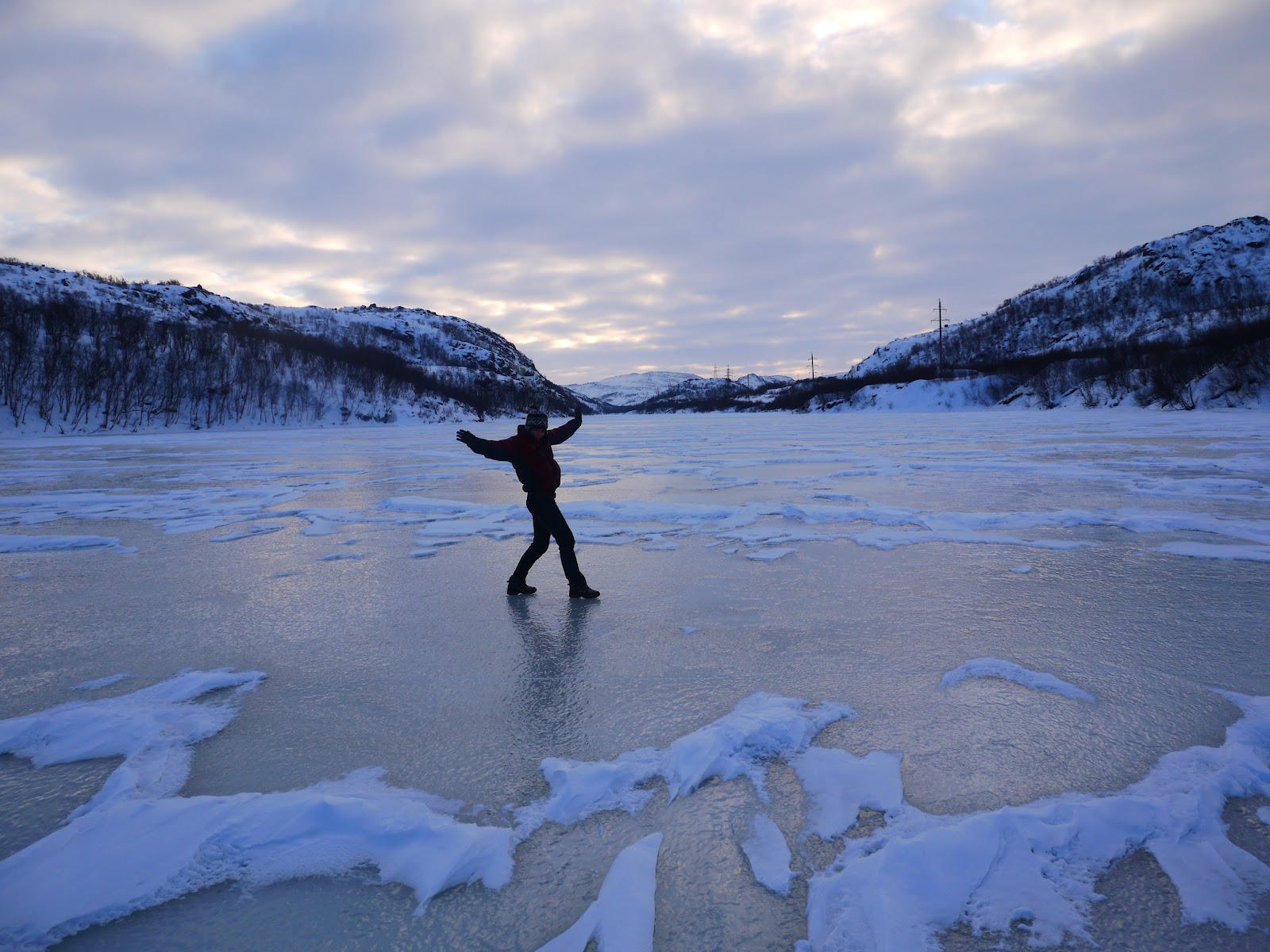
 After lunch we  had the sad realization that ice skates would have been so worth the weight on this journey....And Kelly apparently recovered from her post-fall cryophobia...

 Never too cold for some Tebowin'...


 We aren't kidding! This lake is actually an ice - highway!


We spent our last day on Baikal doing a hike across the lake. We learned very early how Baikal became the largest freshwater lake in the world and will eventually become the world's next ocean - lots of seismic activity as Baikal is situated on a continental rift. There is nothing better to warm frozen...everything, than the fear induced by walking across a frozen lake when a small earthquake occurs underneath you. 


 The siesmic activity certainly explains all of the jagged ice...
 You know which way the wind blows in Siberia based on what side of your head is frozen...well, more frozen than the other side.
 We ended our hike across Baikal in Khuzir, the capitol city of Olkhon Island.

 Siberia is known for its wooden architecture - as it is home to the largest forest in the world, the Taiga Forest.
 Olkhon Island is considered one of five poles of Shamanic energy in the world because of this rock...We have more information about this area, it's reputation, and the photos featured in the short film at the top.

The Buryat people (the natives to Olkhon Island) leave scarves and coins as offerings for one of their Gods who they believe lives in "Shaman Rock." 

 A whole new kind of sushi...
 Step 1: Wrap frozen fish in towel. Step 2: Bang bag with hammer. Step 3: Eat.
 A final siberski cheers! 
And a bottle for the road!

Once we left Siberia we took the long journey to Murmansk, Russia - one of the largest cities above the Arctic Circle. Along the way we made stops in Moscow and St. Petersburg. We will write more about these city centers in a later post. 

We started our trip in Murmansk with something Russia is more famous for than its vodka: its pies! 
 Fish pie!
 Cloudberry Pie! Cloudberries only grow in the Scandinavian region...
And gooseberry pie!

We were hosted by a lovely couple in Murmansk, Dmitry and Svetlana. Their flat was amazing and therapeutic. They designed their apartment to spark the senses after a day out in the bitter grey cold...
We celebrated the beginning of "Maslenitsa", AKA butter week, or pancake week (the Eastern Orthodox version of Mardi Gras) in Murmansk. 

The next day we ventured back into the Russian tundra to head to the small fishing village of Teriberka on the coast of the Arctic Ocean.


The Barrents Sea flows into the bay of Teriberka. This sea catches a stream from, of all places, the Gulf of Mexico! This warm stream prevents the water from freezing.




Dmia's and Sveta's car kept us safe on our journey, until....

Unfortunately, on our way back to Murmansk on several centimeters of ice, over frozen tundra covered in snow, the driver lost control and we found ourselves head on with a guardrail. Sadly, Dmia's and Sveta's car looked a lot like Kelly's face at the beginning of our journey through Russia - but, most importantly, we all made it out unhurt. 

We brought our spirits up with some "Mexican food" at a local restaurant (although I use that term loosely). We were joined by a fellow couchsurfer from Poland who introduced us to several things -  namely, throat singing! This is a rather difficult instrument to describe, so we have included a video below.  

Throat Singing with the Polish Photographer, Marcin.
(You can follow his work on his blog, nomad123.blogspot.com)

The sound is made with the aid of this instrument...


We finished our journey with our bravest feat yet.
In Russia they call it, "Zakalyvanie," which means "straining in cold water" or "hardening the organism." For short, it is known as "winterbathing" or "walrussing". Russians believe it strengthens the immune system to injure your body in cold water. Many people will swim daily in frozen lakes for anywhere from several seconds to several minutes (if they have trained for years). We lasted only a couple seconds and were proud of ourselves for even making it outside in our skivvies in -6 degree weather with skiiers passing by...


Saturday, February 18, 2012

Lessons From a Developing Democracy: Police, Protests, Prisons, and Public Libraries

Following Mongolia’s break from the Soviet Union in 1990, the country transitioned to a free market democracy. Within a year of this transition the country’s parliament signed and ratified numerous human rights treaties including the Convention on the Rights of the Child (CRC) and the International Covenant on Civil and Political Rights (ICCPR). These treaties and others laid the foundation for the drafting of their national constitution in 1992. Among Mongolia’s other unique qualities is its constitution – the preamble of which explicitly names human rights as one of the government’s top priorities: “We, the people of Mongolia…cherishing human rights and freedoms…hereby proclaim the constitution of Mongolia…” From there, three articles specifically enumerate human rights protections related to various treaties to which the country has committed itself. To date, Mongolia has ratified 29 international human rights treaties. The United States of America, by comparison, has ratified only six. A Human Rights Commission that operates independently from the government and is in full compliance with United Nations' standards monitors the implementation of these treaties. This commission annually holds a “human rights open day” to promote implementation standards, raise awareness about human rights, train public officials and receive complaints from citizens.

Although Mongolia has laid a foundation for the development of a truly free and functioning democracy, the country is certainly not without its problems – however, where Mongolia has succeeded and continues to progress are equally as important. As the films below reveal human rights issues realted to freedom of assembly (Article 20 UDHR), the United Nation's Convention on the Rights of the Child (CRC), and freedom of information (Article 19 UDHR) are being widely discussed within Mongolia as it continues its transformation.

The first film, “Policing in Mongolia”, outlines an area in which Mongolia is perhaps most threatened. According to a recent public opinion poll, 49% of Mongolians believe the Judiciary to be “corrupt” and to hold nearly the lowest level of public trust. During our conversations with activists and Mongolian citizens we found that the police were frequently referenced as a dangerous and threatening force. In 2008, this tension came to a head following the parliamentary elections in a rebellion known as “July 1”.

(Music by: Quiza, "Zuud"; Tenuun Ft. Quiza, "1 Sariin 7") 
Although the July 1 rebellion ended with murders and mass arrests, the spirit of protest in the country was not derailed. On the contrary, protest and demonstrations have only increased. Fortunately, the July 1 incident also brought to the forefront a weakness in Mongolia’s government and mass trainings have since been ordered for police. Policing continues to be an issue, but since the rebellion of July 1 there has not been an incident as tragic and unjust.

One of the most active organizing bodies in Ulaanbaatar (the Capitol City of Mongolia) is the Trade Union (CMTU). As the film below summarizes, this body is committed to protecting working people and their families. What was most inspiring about witnessing these demonstrations during our time in Ulaanbaatar was the fact that not only were the people protesting (mind you outside in -10 degree weather), but the government was listening.
(Muisc by: Live performance by Toto, recorded)
The CMTU is one of the most active organizations - in part because economic issues are of increasing importance to the people of Mongolia. Since the fall of the Soviet Union the number of families living in poverty has increased dramatically. The social safety net, although still larger in Mongolia than elsewhere (with 20% of the budget going toward health, education and the protection of children) is still far below what existed during the time of Soviet influence. Graduation rates have plummeted and currently (with nearly half of the population being under the age of 18) nearly a third of these youth are living with families who survive on less than $0.68 a day. Additionally, Mongolia’s mass underground sewer system (because of extreme winter weather - with lows often reaching - 50) is A home to an estimated 1000 homeless youth on a daily basis. This rise in poverty has coincided with a rise in juvenile crime. Although Mongolia is facing a crisis of poverty and is able to provide few opportunities for its youth, it has -  by no means, given up on its children. In comparison to the United States which annually transfers 200,000 youth to the adult criminal justice system, Mongolia transfers none.
(Muisc by: Live performance by Toto, recorded)
While, Mongolia’s prison system in no way ideal and is in the middle of large-scale transformation to truly meet the standards of the human rights treaties they have ratified,  the Government has  opened itself  to the influence of many Non Governmental Organizations (NGOs). This spirit of transformation is also fueled by the development of a public library system and gradual movement toward a more open and honest public information system. Though we in the United States often discuss public libraries as “obsolete” and fewer and fewer of us possess a library card, those working to develop a public library system in Mongolia remind us what many of our United States citizens and leaders have adamantly declared in the past:

Libraries are…essential to the functioning of a democratic society…libraries are the greatest symbol of the freedom of the mind.
 – Franklin D. Roosevelt.
(Muisc by: Live performance by Toto, recorded)

Wednesday, February 8, 2012

The Land of Big Sky: A Week in Ulaanbaatar, Mongolia

And so the Trans-Siberian railroad trip has begun! First stop, Mongolia!
Fortunately, with enough advanced planning, we were able to get hard-sleeper tickets for our 27 hour trip to Ulaanbaatar, Mongolia. This train ride was rather uneventful with the exception of what can be considered - only in retrospect -  funny. Lesson learned: At the border crossing between China and Mongolia if  you exit the train you will have to remain at the station for several hours.  This small (but important) fact had alluded us.  Unfortunately, as the train pulled away, Kelly found herself locked in a nearly empty station in only her long underwear and a pair of slippers,  holding duty-free snacks and our last remaining yuen (because her passport had been taken by customs for processing). After many frantic moments using universal hand signals while trying to relay "I am supposed to be on that train/My friend was left at the station", we learned that Mongolia and China use different tracks, which requires all of the train's wheels to be replaced at the border crossing. Once the wheels are changed, the train rolls back to the station where duty free shoppers who had exited the train are allowed to reboard.

We made it to Ulaanbaatar - and were greeted by highs of -10 and lows of -45. Never have we experienced this type of cold and we quickly learned the phrase "extreme tourism" to describe our ventures around the city. We were able to spend only 10-15 minutes outside before we had frozen toes and fingers and feelings of frostbite in our faces - even when it was entirely covered.  Our host in Mongolia taught us that at the beginning of January, Mongolian's begin to measure weeks in 9 day stretches - each colder than the last. The nine day stretch in which we were in Mongolia was the 4th stretch and the coldest. However, he also taught us "Cold is not a problem for us.  We are happy to feel that human;  the nature is our God!"
In the background of this photo is Ulaanbaatar's Parliament building. Sitting on the steps of Parliament is Mongolia's main man, Chinggis Khaan (in the west known as Genghis Khaan). Although he is often regarded as a bloodthirsty barbarian because of his mass conquests across Asia (at one time controlling the entire region from modern day Europe to the Pacific Ocean), in Mongolia he is a national hero. Opinion of Chinggis Khaan is changing around the world as more is learned about his diplomacy. In addition to being a skilled warrior, he is credited with creating Mongolia's first written law and the first form of written script. As for ruling his people, he allowed religious freedom - a rarity at the time. He was voted by both Time Magazine and the Washington Post to be the "Man of the Millenium."
We were incredibly lucky to befriend Begzsuren Jamsranjav HarUhert and his wonderful family. They hosted us at their lovely home in the Ger District of Ulaanbaatar. In the US we know Gers as "yurts". In Mongolia, Gers are a very traditional form of housing and are the norm in the countryside where the people still live nomadically. Ulaanbaatar did not move from nomadic culture until about 300 years ago. 


When in doubt and stumped by a language barrier, always go with Michael Jackson...

From the warmth of their Ger, we learned a great deal about Ulaanbaatar. We compiled a short film about the Ger District, Mongolian food, music and dancing....

(Special Thanks to Mungulung, Gaadmaa, Menojin and Toto for their performances)

We had a lot to learn from Begz and his family. During our time in Mongolia, we tried our best to assist with some of the daily household chores, though we were quick to learn that our lifestyle and theirs are vastly different.  One afternoon we accompnied Begz up to the mountain to help feed the cows. Begz and his family rely on the cows for milk (a huge staple of the Mongolian diet) and, eventually, for meat. 


On Saturday, we attended the daily Buddhist prayer service at the Gandan Monastery. The predominant religion in Mongolia is Tibetan Buddhism. The Gandan is one of the only monasteries to escape the communist purges of the 1930s. Josef Stalin ordered the destruction of all temples and in the process over 15,000 Lamas were killed. . In addition to photos, we were able to capture a small amount of footage of a  service in one of the many temples in the Monastery.

Buddhist prayer wheels surround the Gandan Monastery...

As do pigeons....


We also had the privilege to meet with several human rights workers fighting to improve issues that are fundamental to Mongolia's success as a developing democracy:  the right to protest the government, policing, prisons and access to public libraries. In the next several days we will be posting a four part video series on human rights in Mongolia.  

Sunday, February 5, 2012

"Help, I Don't Want to Die - Please Don't Kill Me": Capital Punishment in Asia

According to the United Nations, as of 2008, 141 countries had abolished the death penalty. Only 56 countries still allow the death penalty; however, of those that still allow it, only 18 actually performed executions in 2009. In the countries where the death penalty has been abolished, there is no evidence to suggest that crime rates raised or lowered following abolition - it simply had no impact on criminal acitivity.

Huge strides to end the death penalty have been occurring across Asia over the last several years. South Korea has been execution free for 10 years. On January 1, 2011 Russia's Constitutional Court ordered a stop to all executions. Most recently,  on January 5 of this year, after the President of Mongolia declared a moratorium on executions in 2010, the Mongolian Parliament ratified the second optional provision of the International Covenant on Civil and Political Rights. This protocol instructs the ratifying country to cease all executions and take the necessary steps to fully abolish the death penalty.

Although the world is moving away from the death penalty, it is estimated that China performed over 5000 executions in 2009. As in the United States, the vast majority of people facing execution in Asia are poor and cannot afford proper legal representation.

Fortunately, in 2007, China instituted a sentencing option called the 'sinhuan' which requires that all death penalty cases go to the Supreme Court for review before an execution is carried out. This order has cut the number of executions in half. Further, in March of 2007, the head of the Chinese delegation to the Human Rights Council stated, "we are seeking to limit the application of the death penalty in China...I am confident that with the development and progress in my country, the application of the death penalty will be further reduced and it will finally be abolished".

Although President Barrack Obama has stated that he believes the death penalty is appropriate in certain cases, he has also acknowledged the fact that the criminal justice system in the United States is broken and applied unfairly. To date, neither China or the United States have ratified the International Covenant on Civil and Political Rights (ICCPR) or any of its optional protocols.

The main provisions of the ICCPR also order that no child shall be sentenced to life without the possibility of parole.